By Jean Baptiste Ndabananiye
With 56 active conflicts and an unprecedented 92 countries involved in battles beyond their borders, the landscape of peace in the world seems to be regressing rather than progressing. The current state of global affairs paints a bleak picture of escalating violence and instability. These conflicts are not only more numerous but also increasingly international, reflecting a worrying trend towards global entanglement. The proliferation of conflicts constitutes an ominous indicator that the seeds of larger wars may be being sown.
Last year alone saw 162,000 conflict-related deaths, the second highest toll in three decades, driven largely by the wars in Ukraine and Gaza which accounted for nearly three-quarters of the fatalities. If the current trajectory continues, with 47,000 deaths recorded in just the first four months of 2024, we could be heading toward one of the darkest moments for global peace, especially in the years to come. What does this surge in global conflict really mean for our future, and how can we interpret this alarming data to prevent a further descent into chaos? This article comprises these sections:
- Global militarization
- The most and least peaceful places in the world, according to VOH
- Causes of the convoluted conflicts being witness across the world
- Consequences demonstrated by facts and true stories
- Consequences demonstrated by facts and true stories
- Is proposed action possible?
Established in 2008, Vision of Humanity (VOH) is a destination for peace providing research, data, editorial and analysis of the world today through a lens of peace, security and development. VOH forms part to and is powered by research, data and analysis by the Institute for Economics and Peace (IEP), a global think-tank devoted to analyzing relationships between peace, economics, and development.
VOH highlights that the world sits at a crossroads. “Today (June 11, 2024) marks the launch of the 18th edition of the Global Peace Index (2024) from international think-tank, the Institute for Economics & Peace, revealing that the world is at a crossroads. Without concerted effort, there is a risk of a surge in major conflicts.”
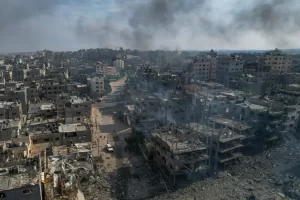
The IEP is best known for the Global Peace Index (GPI), which ranks countries and regions based on their levels of peacefulness. This institute conducts research and generates reports furnishing insights into the economic benefits of peace, the drivers of conflict, and factors that buttress peaceful societies.
“There are currently 56 conflicts, the most since World War II. They have become more international with 92 countries involved in conflicts outside their borders, the most since the GPI’s inception.
The rising number of minor conflicts increases the likelihood of more major conflicts in the future. For example, in 2019, Ethiopia, Ukraine, and Gaza were all identified as minor conflicts,” discloses the GPI 2024 before adding “Last year recorded 162,000 conflict related deaths. This was the second highest toll in the past 30 years, with the conflicts in Ukraine and Gaza accounting for nearly three-quarters of deaths.
Ukraine represented more than half, recording 83,000 conflict deaths, with estimates of at least 33,000 for Palestine up to April 2024. In the first four months of 2024, conflict related deaths globally amounted to 47,000. If the same rate continues for the rest of this year, it would be the highest number of conflict deaths since the Rwandan genocide in 1994.” The GPI was introduced in 2007.
VOH points out that as conflicts get more widespread and more internationalized, increasing complexity decreases the chances of attaining lasting solutions. “Ukraine and Gaza are examples of ongoing historical grievances or ‘forever wars’ without clear resolutions. The number of conflicts resulting in a decisive victory for either side has fallen from 49% in the 1970s to less than 9% in the 2010s. Over the same period, the number of conflicts that ended through peace agreements fell from 23% to just over 4%.”
According to VOH, the impact of asymmetric warfare technology constitutes another major factor altering the conflict landscape, enabling non-state groups and smaller or less powerful states to compete in conflicts with larger states or governments. “The number of states using drones rose from 16 to 40, a 150% increase between 2018 and 2023. Over the same period, the number of non-state groups which committed at least one drone attack rose from 6 to 91, an increase of over 1,400%.”
Asymmetric warfare technology refers to the use of advanced or unconventional technologies by a weaker party to counterbalance advantages of a stronger opponent in a conflict. Asymmetric warfare itself is characterized by the use of unconventional tactics and strategies by a less powerful entity, such as a non-state actor or smaller military force, to exploit the vulnerabilities of a more powerful adversary.
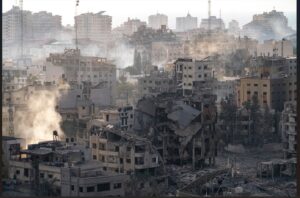
The Gaza war has exacerbated mutual negativity between Israel and Palestine. VOH reports “Highlighting the growing tensions, Israeli media stories with a negative sentiment towards Palestinians increased from just over 30% in 1999 to 92% in early 2023, while stories with negative sentiment by Palestinian media towards Israelis increased from just under 30% in 1999 to 85% in early 2023.”
A situation which prevailed in the recent years, with peace dwindling across the world, underlines that the world has not yet been prepared to embrace peace. “Over the past decade, peacefulness has declined in nine out of the ten years. We are witnessing a record number of conflicts, a rise in militarisation, and heightened international strategic competition.”
Global militarization
VOH states that since the beginning of the Ukraine war, militarization has intensified in 91 countries, reversing the trend of the prior 15 years. There exists little hope that the current situation will be inverted. “Given the forward commitments of many countries to military spending, it is unlikely to improve in the coming years. Changes in the dynamics of warfare have seen troop numbers decrease while technological sophistication has increased. Over the last decade, 100 countries reduced their armed forces personnel, while global military capability increased by over 10%.

First of its kind research by IEP calculates the military capability of countries by combining military sophistication, technology, and combat readiness. It reveals that the US has substantially higher military capability than China, which is closely followed by Russia. Traditional approaches to measuring military capability generally count the number of military assets only.”
The most and least peaceful places in the world, according to VOH
GPI 2024 states “Iceland remains the most peaceful country, a position it has held since 2008, followed by Ireland, Austria, New Zealand, and Singapore – a new entrant in the top five. Yemen has replaced Afghanistan as the least peaceful country in the world. It is followed by Sudan, South Sudan, Afghanistan, and Ukraine.”
“Conflict has thrown the entire Middle East region into crisis, involving Syria, Iran, Lebanon and Yemen, with the economic consequences mounting and a high risk of open warfare.”
The Middle East and North Africa (MENA) stays the least peaceful region in the world. This region is home to four of the ten least peaceful countries in the world and the two least peaceful, Sudan and Yemen. VOH highlights “Despite this, the UAE [United Arab Emirates] recorded the largest improvement in peacefulness in the region – rising 31 places to 53rd in 2024.”
According to VOH, Sub-Saharan Africa represents now the second least peaceful region behind MENA as “it faces several security crises – most notably increasing political unrest and terrorism in the Central Sahel.”
Europe constitutes the most peaceful region, “though it recorded a slight deterioration in peacefulness. Asia-Pacific remains the second most peaceful region with a slight decline in peacefulness. Papua New Guinea recorded the worst deterioration in the region, caused by intensified tribal violence from disputes over territory and land ownership. North America recorded the largest regional deterioration in peacefulness with a drop of just under 5%.”
“Both the US and Canada saw significant falls, primarily driven by increases in violent crime and fear of violence. Central America and the Caribbean experienced a minor decline in peacefulness, as countries like Haiti battled high levels of organised crime and civil unrest. Despite this, El Salvador recorded the world’s most significant peace improvement. South America experienced the second largest fall in peacefulness with a deterioration of 3.6%. The largest changes occurred for the Homicide Rate, Political Terror Scale, and Intensity of Internal Conflict indicators.”
Causes of the convoluted conflicts being witness across the world
These conflicts are so complex that simple solutions are not feasible; instead, requiring multifaceted approaches which remedy the political, economic, social, and historical dimensions of the issues. It signifies that these conflicts are continuing to rage, because of their complexity which is being improperly addressed. Several reputable organizations have also highlighted the complexity of modern conflicts, underlining that simple solutions are not fruitful and that solving these issues demands multifaceted approaches. The United Nations is one of these organizations.
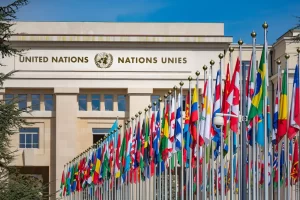
The UN, through its peacekeeping missions and diplomatic efforts, frequently states that peacebuilding necessitates comprehensive solutions addressing root causes such as those pertaining to governance, human rights, and socio-economic disparities. The UN’s Sustainable Development Goals (SDGs), particularly SDG 16 (Peace, Justice, and Strong Institutions), stresses the need for inclusive, multi-dimensional approaches to conflict resolution.
UN Press is the UN’s organ providing information about the UN’s work relating to international diplomacy, peacekeeping, development, human rights, humanitarian issues, and global governance. Its 20 October 2023 article emphasizes that comprehensive mechanisms need to be taken, to successfully handle conflicts.
The article is situated in the context of a day-long open debate on the contributions of regional mechanisms for peace and security. More than 60 speakers highlighted successful initiatives to that end and provided concrete proposals to buttress conflict prevention and peace efforts amid an increasingly adversarial geopolitical landscape.
Josefina Echavarría Álvarez, the Director of the Peace Accords Matrix (PAM), pointed out that most peace agreements fail when they are not comprehensive in relation to issues they address, “when not all actors and stakeholders are engaged in negotiation and implementation and, importantly, when a peace accord lacks strong and independent verification and monitoring mechanisms”.
Alya Ahmed Saif Al-Than, representing Qatar in the dialogue, said that United Nations must adopt a comprehensive approach to address the root causes of conflicts, especially the one in the Middle East. She seized an occasion to reaffirm support for the Secretary-General’s Our Common Agenda and A New Agenda for Peace.
Our Common Agenda and A New Agenda for Peace also acknowledges the criticial importance of comprehensive mechanisms for effectively resolving conflicts. It reads “Prioritizing comprehensive approaches over securitized responses. Responses to violence, including addressing the threat posed by non-state armed groups such as terrorists and violent extremists, cannot be effective if not part of a comprehensive approach with a political strategy at its core.
Failure to tackle the root causes of violence can lead to oversecuritized responses, including in counter-terrorism and counter-insurgency operations. These can be counterproductive and reinforce the very dynamics they seek to overcome, as their far-reaching consequences – blowback from local populations, human rights violations and abuses, exacerbation of gender inequalities and distortion of local economies – can be powerful drivers for recruitment into terrorist or armed groups.”
The UN’s Secretary-General António Guterres presented this document termed ‘his Policy Brief on A New Agenda for Peace’ on 20 July 2023.
Consequences demonstrated by facts and true stories
If the escalating global violence and instability sinks into impasse, it will result in several disastrous consequences. The latter ones include economic instability and recession, mass displacement and refugee crises, humanitarian catastrophe, and global terrorism and extremism, among others. A more alarming issue is that these consequences will not be limited to one country or region.
For example, VOH predicts that the conflict in the Middle East will be profoundly felt worldwide in terms of economy, if it expands. “A further broadening of the conflict would severely impact the global economy, potentially triggering a worldwide recession.
Highlighting the point, Syria’s economy shrunk by more than 85% after the start of the civil war in 2011, and the Ukrainian economy shrunk by 29% in the year after the onset of the conflict in 2022.”
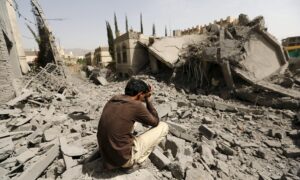
The consequences of war and conflict are felt by all creatures, but especially by human beings. A story, from those crafted by Save the Children in its piece titled ‘War in Yemen: Six Years, Six Stories,’ emphasizes the disastrous effects of war, with a particular focus on the impact on children.
This piece doesn’t specify the date on which it appeared, but it is likely that it was published in around 2021, since the war broke out in 2015 in Yemen. Save the Children said “As Yemen marks six years of conflict, its people are suffering the biggest humanitarian crisis in the world. Civilians – especially children – continue to pay the heaviest price.”
“This is a man-made disaster resulting from a conflict that is being waged with near-complete disregard for the civilian population’s well-being and safety,” said Janti Soeripto, President and CEO of Save the Children.
The story is that of Sadam. Save the Children mentioned 14 as his age, but did not clarify whether he was 14-years old during the production of the stories or when the war began. This is his story.
Sadam witnessed his father be killed in an airstrike. “One day I was in the market with my father and I heard planes flying above,” he said. “An airstrike hit the area [where] we were. My dad died instantly and I was injured in the leg. I had been shouting for help and crying for about two hours until someone found us and took me to the hospital.”
Sadam’s leg was injured so badly that, despite surgery, he cannot walk on his own, according to Save the Children. After the airstrike, Sadam’s mother took him and his sister and fled. This organization added that his recovery, both emotionally and physically, was slow. Save the Children reported that it provided Sadam with mental health support as well as financial support for his family.
Sadam was however resolved to serve in the field of medical treatment; which is connected with the problem that he has faced. “When I grow up, I want to become a doctor so I can help people who are sick and injured.”
World Food Program (WFP) USA in its 1 February 2024 article, says “Yemen is among the poorest countries in the Middle East and North Africa region. It ranks 183 out of 191 countries in the Human Development Index. Out of its population of 32.6 million people, 80% fall under the poverty line which means they live on less than $2.15 a day. Poverty in Yemen has been accelerated by years of conflict.”
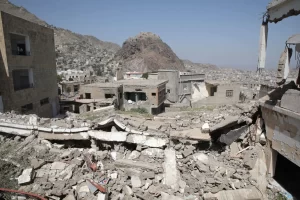
“Eight years of war in Yemen have taken a devastating toll on civilians. The conflict has claimed over 377,000 lives and displaced 4.5 million people. 21 million people need humanitarian assistance, and 17 million people in Yemen are extremely hungry .The conflict has destroyed the country’s infrastructure, including major roads and airports. The collapse of the economy, high cost of goods and devalued currency make it very difficult for people to access basic necessities.”
The war in Yemen has not stopped decisively, with ongoing conflict and instability despite various truce agreements and negotiations. WFP USA says “In 2022, the United Nations brokered a truce that was renewed and extended multiple times. Though the truce expired in 2023, conflict has remained minimal as negotiations continue.”
The Security Council Report has published its September 2024 Monthly Forecast. It states that the UN Special Envoy Hans Grundberg reiterated his warning on 15 August 2024 that the precarious environment in the Middle East threatens to plunge the country further into conflict. He added that it could overturn gains achieved since Yemen’s April 2022 truce.
He highlighted that continued attacks by the Houthi rebel group on commercial shipping in the Red Sea and retaliatory US-led strikes against Houthi targets have caused an unsustainable situation. “In a recent worrying development, the Houthis claimed responsibility for a 21 August attack in the Red Sea against the Greek-flagged crude oil tanker Sounion, reportedly carrying 150,000 tonnes of crude oil. The vessel, whose crew was evacuated, has been on fire since 23 August, raising concerns about a potential environmental catastrophe. At the time of writing, no signs of an oil spill had been reported.”
Grundberg asserted that the regional escalation was occurring in parallel with “real and urgent challenges” inside Yemen. “Although the levels of violence along the front lines remain lower than before the 2022 truce, ongoing military preparations and reinforcements by the Yemeni parties and reports of clashes in areas such as Hodeidah and Taiz governorates continue to demonstrate the volatility of the situation,” the report says, quoting Grundberg.
Is proposed action possible?
Steve Killelea, Founder and Executive Chairman, IEP, says “It is imperative for governments and businesses worldwide to intensify their efforts to resolve the many minor conflicts before they escalate into larger crises. It’s been 80 years since the end of WWII, and the current crises underscore the urgency for world leaders to commit to investing in resolving these conflicts.”
The UN’s Secretary General’s policy underscores that the challenges that the world is experiencing can be addressed only through stronger international cooperation, entailing comprehensive approaches.
Life In Humanity contends that if world leaders are actually determined to transform the current conflicts, the latter ones will really be ended. But, are they determined to do so? Life In Humanity cannot respond to it accurately. This will become clear over time, as decisions only matter when they are implemented and yield positive results.